
25 & 28.09 | 9 – 5 PM (CEST) | Online
Workshops Package
Scalable Architecture & Modern Reactivity +
Signal Forms
Early Bird (-30%) pricing is now open!
Is it for you?
The Angular ecosystem is evolving toward “Zone-less” performance and full signal-based reactivity. Clinging to outdated patterns such as complex RxJS chains, manual subscriptions, and monolithic structures results in technical debt that stifles your team’s growth.
This bundle is designed for you if you aim to modernize your development workflow comprehensively. Instead of piecemeal learning, you will gain a cohesive skill set: understanding how to establish robust architectural frameworks and populate them with modern, lightweight form logic. It is an investment that empowers you to write code with confidence and speed, aligned with the latest Google standards.
Day 1. Scalable Architecture & Modern Reactivity
Architecture Takeaways
Architect Scalable "Moduliths" with Nx
Move beyond simple file organization. Learn to structure your workspace into Feature, UI, and Data-Access layers to create a clean and maintainable Modulith.
Visualize & Enforce Boundaries
Stop architectural rot. Use the Nx Graph to visualize dependencies in real-time and configure ESLint rules to prevent business logic from leaking into your UI components.
Master Fine-Grained Reactivity
Understand the shift from Zone.js to Signals. Learn how the Signal Graph works and how to use computed() , linkedSignal(), effect() to update only what changes, when it changes.
Modernize Component I/O & Forms
Say goodbye to @Input() decorators. Implement the new Signal-based input() , output() and model() APIs for cleaner component communication and integrate the new reactive Signal Forms.
Simplify Data Fetching with Resources
Reduce RxJS boilerplate. Learn to use the new rxResource patterns to handle asynchronous data loading, error states, and reactivity without complex pipe chains.
Master Declarative Data Flows
Stop manually updating data. Learn to chain Signals together so your application state automatically stays in sync without writing complex code.
Architecture Agenda
Workshop Lead: Fanis Prodromou (GDE)
Duration: 8 hours.
Regular Price: 399 EUR
Date: 25.09
Nx Architecture: Building Scalable Monorepos
- The Modulith Pattern – Organize apps into self-contained “Moduliths” for scalability.
- Layered Architecture – Master separation of concerns using Feature, UI, and Data-Access layers.
- Workspace Mastery – Efficiently manage the
appsvslibsstructure using the CLI and Console. - Lazy Loading – Configure clean routing using Feature Libraries as entry points.
Enforcing Boundaries & Visualizing Dependencies
- Dependency Graph – Visualize architecture and data flow in real-time with
nx graph. - Affected Analysis – Identify exactly which projects are impacted by code changes.
- Architectural Rules – Use tagging and ESLint
constraintsto prevent circular dependencies. - Intentional Failure – Debug linter errors to understand strict code boundary enforcement.
Signals Core & Fine-Grained Reactivity
- Signal Fundamentals – Master the basics of
signal()vs variables vs Observables. - State Derivation – Use
computed()for automatic, memoized state calculations. - Side Effect Management – Manage DOM updates and logging cleanly with
effect().
Advanced Signals & Data Flow
- Declarative I/O – Implement the modern
input()andoutput()APIs. - Resettable State – Manage derived state updates with
linkedSignal. - Async Data Flow – Handle async loading states using
rxResourceortoSignal. - Signal Forms – Build reactive forms using the experimental
form()API.
(NEW) AI topics
Workspace Intelligence & The "Context Gap"
- The “Context Gap” Explained: Why standard, text-only prompts fail in monorepos because they see individual files but miss the high-level architecture.
- Instant Architectural Understanding: Using the $nx\ graph$ as a “Source of Truth” to feed AI agents a structured map of 150+ libraries.
Framework Intelligence: Signals & Angular MCP
- Powering Modern Angular: Installing framework-specific Agent Skills and MCP Servers
- The Synergy Model: Using Nx as the “Map” to find code and the Angular MCP as the “Expert Tools” to refactor it.
- Future-Proofing the Stack: Using automated tools to modernize legacy code and stay up to date with modern reactivity.
AI-Assisted Signal Migrations
- Automated Refactoring: Using AI to safely convert legacy RxJS streams and
@Input()decorators into modern Signals,input(), andoutput()APIs. - Zoneless Readiness: Delegating the heavy lifting of state migration to agents that respect your workspace’s Architectural Guardrails and Tags.
- Safe Scaffolding: Using the
nx-generateskill to create new features with signal-based boilerplate automatically. - Workflow Blueprints: Real-world examples of automated discovery, architectural auditing, and mass Signal migrations.
Day 2. Signal Forms
Signal Forms Takeaways
Reactive Forms vs Signal Forms
When to migrate? What do you gain? What to expect during the transition
Master Signal Forms syntax from the ground up
Creating form models, field trees, template binding - practical step-by-step examples
Build custom form controls
Creating reusable form components integrated with Signal Forms
Implement advanced validation
From custom validators to asynchronous data checking - with real-world examples
Design scalable architectures with Schemas
Create your own schemas, reusable patterns, and DRY forms in enterprise applications
Apply production-ready best practices
State management, updates, performance optimization, and maintainable code patterns
Signal Forms Agenda
Workshop Lead: Mateusz Stefańczyk (GDE)
Duration: 8 hours.
Regular PRICE: 349 EUR
Date: 28.09
Foundations
• Welcome & Introduction
• Reactive Forms vs Signal Forms – pain points solved, migration strategies, when to use each
• Signal Forms Syntax & Fundamentals – form models, field trees, [field] directive, two-way binding
Form Architecture
• Working with Form Models – reading/updating models, nested structures, arrays, dynamic fields
• Custom Form Controls – reusable components, integration patterns
• Advanced Validation – custom validators, cross-field validation, async validators, error handling
Scalable Architectures
• Schema-Based Forms – reusable schemas, composition patterns, type-safe design
• Enterprise Patterns – form orchestration, sharing schemas, state management integration
Production Ready
• Best Practices & Performance – model design, initialization strategies, optimization techniques, testing
• Real-World Case Study – complete feature walkthrough, API integration
• Q&A & Wrap-up
Are you interested?
Benefits
Hands-On Exercises
Work on real, practical tasks so you don’t just hear about modern Angular, you actually use it right away.
Q&A Session
Get clear answers to your questions during a dedicated Q&A a chance to clarify concepts and dive deeper into real-world use cases.
Small Group
Maximum of 15 participants, you’ll benefit from more interaction and personalized support.
Certificate of participation
Simple way to show your updated Angular skills to your team, clients, or future employers.
Are you interested?
Our Speakers

Mateusz Stefańczyk
Google Developer Expert
For 9 years, Mateusz has been developing web applications with Angular. He has performed dozens of audits for Angular projects worldwide. Mateusz actively participates in the angular.love community, writing expert articles, and sharing his knowledge at Angular meetups in Poland, Norway, Germany, and the UK.

Fanis Prodromou
Google Developer Expert
Google Developer Expert (GDE) for Angular and Senior Front-End Developer. He is passionate about sharing his knowledge through his YouTube channel, speaking at conferences and meetups, and technical articles. He also stays current in the ever-evolving tech world by attending conferences and experimenting with new technologies, and is a co-organizer of the Angular Athens meetup in Greece.
What developers say about our workshops?

I highly recommend Modern Angular Workshops.
Mateusz deep knowledge makes it really beneficial.
Workshops helped me take my signal skills to another level and I hope that I will have opportunity to participate once again.
– Jakub
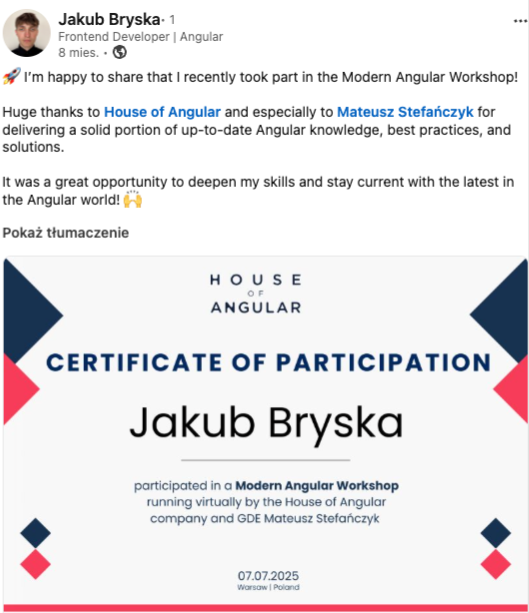
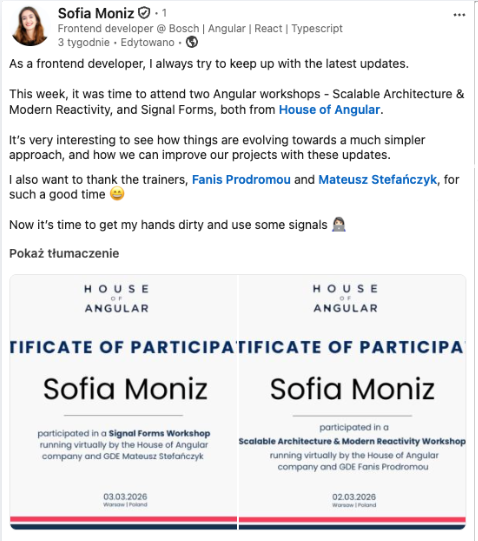
I thoroughly enjoyed attending the two-day workshop. The trainers were very friendly and approachable, making the learning experience engaging and supportive. Even after the workshop, they remain available to help with any questions, which I truly appreciate.
After the trainings, you will have a clear understanding of how to improve your projects with the latest Angular features.
– Sofia
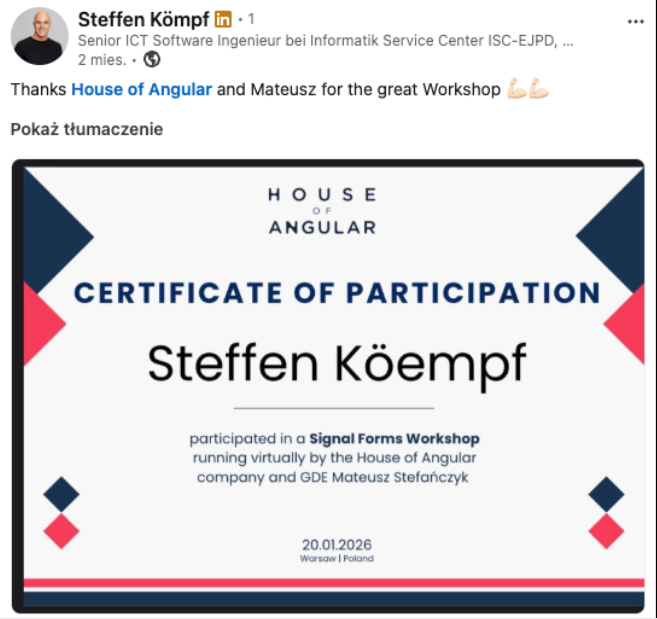
What I appreciated most about Mateusz’s Signal Forms workshop was that he went beyond the basics and tackled real-world use cases — you could tell he really knows what he’s talking about. Fanis did a great job moderating the Scalable Architecture & Modern Reactivity session, bringing years of hands-on Angular expertise to the table. I walked away with ideas I’m already putting into practice.
– Steffen
Attending the camps for the Scalable architecture & Modern Reactivity Workshop along with the Signal Forms Workshop.
First session delivered by Fanis was amazing, from the first slide he showed his passion in the topic and the in depth knowledge that he has in it. I was quite sceptic about NX setup but his slides and practical sessions helped to understand it better and see the benefits that it comes with and how much easier the codebase becomes with NX.
Sessions on Signal forms by Mateusz made me push harder for Angular 21 upgrade at my work. The delivery was exceptional; simple and lab sessions covered each topic in real depth. The labs were easy to follow, expanded on the slides and helped to understand the new features well.
Overall both days were really good in terms of content, delivery and passing on the knowledge of the experts onto participants. Each session was adjusted to the audience in terms of pace, there was always time to ask questions and during practical sessions both speakers had all the time to fix any issues that were raised by us.
– Rafał
Get your tickets
Join us for an online workshop. Secure your spot today!
Architecture
Start at 9AM (CEST) • Duration 8h
25.09 • Early Bird (-30%) Price
399 -> 279 EUR
- 30-min 1:1 session with GDE
- Full-day workshop access
- Hands-on sessions with mentor
- Personal Certificate of Participation
May 18
Start at 9AM (CEST) • Duration 8h
Last Call (-15%) Price
399 -> 339 EUR
- Full-day workshop access
- Hands-on sessions with mentor
- Certificate of Participation
- Q&A Session
Signal Forms
Start at 9AM (CEST) • Duration 8h
28.09 • Early Bird (-30%) Price
349 -> 244 EUR
- 30-min 1:1 session with GDE
- Full-day workshop access
- Hands-on sessions with mentor
- Personal Certificate of Participation
Best value
2- Days Workshop
Start at 9AM (CEST) • 2x (online)
Architecture + Signal Forms
748 → 523 EUR
Dates:
Architecture: 25.09
Signal Forms: 28.09
-
Benefits from Architecture
+ Signal Forms included
Bring This Workshop to Your Team!
Want to upskill your entire dev team? This Angular workshop is also available as a private in-house or remote session, fully adapted to your team’s needs, codebase, and experience level.
Why us?
Projects worldwide
USA, Germany, UK,
Norway, Belgium
Angular experts
Who have coded in Angular
since its release
Years of experience
Building enterprise-scale
web applications
FAQ
Who is this Angular workshop for?
For developers who have been working with Angular but haven’t had time to catch up with the latest changes.
Also ideal for those early in their Angular journey (up to ~1 year) who want to understand modern patterns, architecture, and tooling.
Will the workshop be recorded and available for later access?
No, the workshop will be live only. There will be no recordings available afterwards.
In what language will the workshop be conducted?
The workshop will be conducted in English.
Is there any certification or proof of participation?
Yes, every participant will receive a certificate of participation after completing the workshop.
Do I need to install anything before the workshop?
- Node.js (LTS): The engine that powers our workspace.
- VS Code: Our primary IDE for all examples (WebStorm is also welcome).
- Stable Internet: We will be installing several NPM packages during the first session.
Don’t worry about breaking your current setup. We highly recommend using a Node Version Manager to switch between versions easily:
- macOS / Linux: Use the
npackage or nvm. - Windows: Use nvm-windows.
Workshop Tip: Once you have a manager installed, you can simply runn ltsornvm install ltsto grab the version we need for the workshop without uninstalling your older versions.