
Angular Agentic Engineering: From Spec to Ship
See how AI reshapes the entire software development lifecycle – and learn to deliberately decide what to hand off to an agent and what to keep for yourself.
Is it for you?
If you already use AI to code and have some context set up for your agent, it works fine for simple tasks. But on a larger, multi-library change, the agent still starts guessing, and you end up re-explaining things it “should already know.”
You’ll learn to build this systematically: write the spec before the code, break it into a plan, encode your conventions into reusable Skills, and delegate work to sub-agents – while catching the subtle mistakes agents make before they ship.
Agenda
Hands-on throughout, on a real Nx/Angular codebase. All hands-on work is based on Claude Code. If you use another agentic tool like Cursor or Antigravity, you’ll get a translation handout to follow along.
- 01
Foundations: Vibe Coding vs. Agentic Engineering, the Lifecycle & Context
- Vibe Coding vs. Agentic Engineering — Place your current AI habits on the spectrum from casual prompting to disciplined agentic engineering, and learn when each is the right call for the stakes at hand.
- The SDLC, Reshaped by AI — See how AI transforms every phase of the software development lifecycle, and adopt a shared, AI-driven SDLC as the common vocabulary for the day.
- Conductor vs. Orchestrator — Understand the developer’s evolving role, and why agentic work is a genuinely different mode from autocomplete-style tools.
- Context Engineering: Static vs. Dynamic — Move beyond prompt engineering to the harness that makes an agent reliable — context files, Skills, permission guardrails, and MCP servers, and which category each one belongs to.
- Skills Live, Before & After — Install an official Angular skill mid-session and feed a real design straight into the agent, watching context transform the output on an actual component.
- 02
Spec to Feature: From Idea to Working Code
- Skill Anatomy — Install a production skills plugin and dissect real, battle-tested skills to see exactly how they’re built.
- Spec-Driven Development — Turn a hardcoded, static section into a real feature by writing the spec first, not the code.
- Planning & Task Breakdown — Decompose that spec into small, ordered, verifiable slices before building anything.
- Incremental Build with NgXs — Implement one vertical slice at a time — state, list, and a fully validated form — built against a real design.
- 03
Scaling Yourself: Custom Skills, Sub-agents & Ultracode
- Encode Your Conventions — Author a companion Skill that teaches the agent your workspace’s own architecture, state shape, and boundary rules.
- Delegating to Sub-agents — Hand focused work such as code review to specialized sub-agents running alongside your main session.
- Ultraplan — Plan a genuine multi-library change as a reviewable plan artifact before anything touches the codebase.
- Boundary-Safe Scaffolding — Wire a feature end to end across libraries and confirm your architectural boundaries held.
- 04
The Daily Grind: Debugging, Testing & Review
- AI-Assisted Code Review — Run a review pass that surfaces dead code, risks, and refactoring opportunities in real code.
- Refactoring with Confidence — Restructure existing code while keeping its behavior intact, with the agent doing the heavy lifting.
- Catch What the Agent Misses — A deliberately, subtly-wrong output you have to spot before it ships: the skill that doesn’t rust.
- Testing with Realistic Data — Write meaningful unit tests covering state logic and dynamic form validation, backed by realistic mock data.
- 05
Governance, Guardrails & Wrap-up
- What Stays Human — Walk back through which parts of the lifecycle stayed human-owned all day, and why that answers the “will my skills rust?” worry.
- The Governance Checklist — Leave with a consolidated, take-home reference of what to double-check at every stage.
- Shipping Discipline — Commit hygiene and safe shipping practices, without the CI/CD rabbit hole.
- Your Tool Rosetta Stone — A handout mapping every technique to its equivalent in other agentic tools like Cursor and Antigravity.
Ready to ship real features with AI agents?
Max 15 seats groups. 1:1 GDE mentoring included.
Takeaways
Master the AI-Driven SDLC
See how AI reshapes every phase of the software development lifecycle, from a traditional SDLC to an AI-driven one. Learn which parts of the process stay human-owned and which you can confidently delegate to an agent.
Know Where You Sit on the Spectrum
Move deliberately along the spectrum from casual "vibe coding" to disciplined agentic engineering. Learn to read the stakes of a task and choose the right level of structure, verification, and human judgment for it.
Engineer Context, Not Just Prompts
Understand why clever prompts alone fall apart on a real codebase, and why the shift is from prompt engineering to context engineering. Master the static and dynamic context - the harness - that makes an agent reliable inside your architecture instead of guessing around it.
Encode Your Architecture into Skills
Turn your team's hard-won conventions and boundaries into reusable Skills the agent follows every single time — so output quality stops depending on whether you remembered to re-explain yourself in the prompt.
Plan and Ship Real Features
Build a complete feature the way a senior engineer does — spec first, then plan, then supervised, incremental delivery — using sub-agents and multi-step planning to scope even genuinely complex, cross-boundary changes before any code is written.
Keep the Skill That Doesn't Rust
Practice catching the subtle mistakes agents make in review and testing — the ones that pass silently and slip through. The judgment to know when the AI is wrong is the exact skill this day sharpens.


Benefits

Hands-On Exercises
Real coding tasks, not just slides.

Q&A Session
Time to ask about your own project.

Small Group
Max 15 people, so everyone gets attention.

Certificate
Proof of your updated Angular skills.

1:1 With A GDE
A private 30-min call about your codebase.

Fully Online
Join live from anywhere in the world.
Trained developers
Software engineers, architects and tech leads
Workshop Rating
Based on post-workshop participant feedback
Google Developer Experts
Core contributors to Angular.love, leading the Angular community
Your Trainer

Fanis Prodromou
Google Developer Expert
Google Developer Expert (GDE) for Angular and Senior Front-End Developer. He is passionate about sharing his knowledge through his YouTube channel, speaking at conferences and meetups, and technical articles. He also stays current in the ever-evolving tech world by attending conferences and experimenting with new technologies, and is a co-organizer of the Angular Athens meetup in Greece.
What developers say about our workshops?
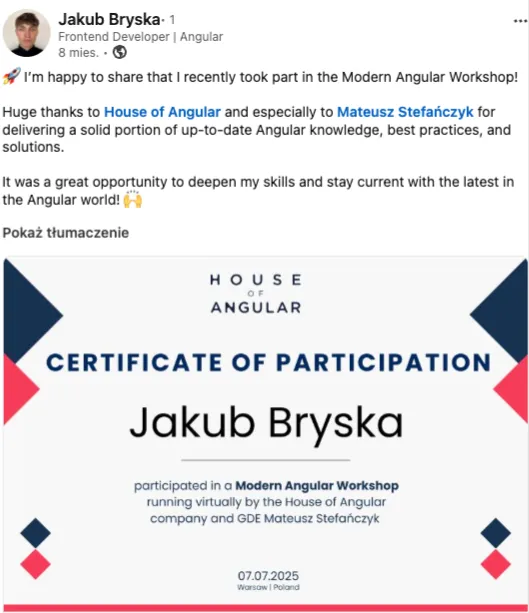
“I highly recommend Modern Angular Workshops. Mateusz' deep knowledge makes it really beneficial. Workshops helped me take my signal skills to another level and I hope that I will have opportunity to participate once again.”
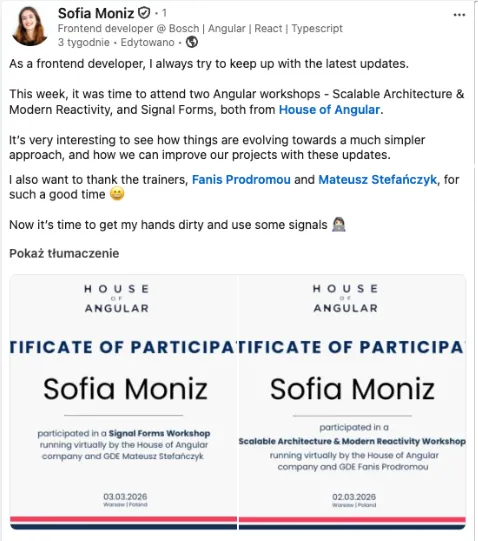
“I thoroughly enjoyed attending the two-day workshop. The trainers were very friendly and approachable, making the learning experience engaging and supportive. Even after the workshop, they remain available to help with any questions, which I truly appreciate. After the trainings, you will have a clear understanding of how to improve your projects with the latest Angular features.”
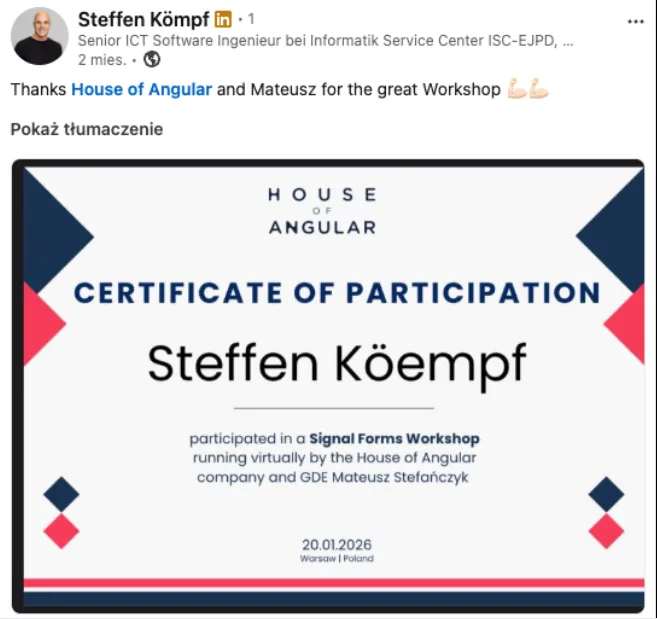
“What I appreciated most about Mateusz' Signal Forms workshop was that he went beyond the basics and tackled real-world use cases — you could tell he really knows what he's talking about. Fanis did a great job moderating the Scalable Architecture & Modern Reactivity session, bringing years of hands-on Angular expertise to the table. I walked away with ideas I'm already putting into practice.”
“First session delivered by Fanis was amazing — from the first slide he showed his passion and the in-depth knowledge that he has. I was quite sceptic about the NX setup but his slides and practical sessions helped to understand it better and see the benefits. Sessions on Signal Forms by Mateusz made me push harder for an Angular 21 upgrade at my work. The delivery was exceptional; lab sessions covered each topic in real depth and were easy to follow.”
Get your tickets
Join us for an online workshop. Secure your spot today!
October 30
Start at 9AM (CET) • Duration 8h
Early Birds (-30%) Price
399 → 279 EUR
- 30-min 1:1 session with GDE
- Full-day workshop access
- Hands-on sessions with mentor
- Personal Certificate of Participation
Team Workshop
Bring this workshop to your team!
Tailored to your needs
- Agenda tailored to your project
- Flexible dates for your team
- Google Developer Expert trainers
- Work on your codebase (optional)
Bring This Workshop to Your Team!
Want to upskill your entire dev team? This Angular workshop is also available as a private in-house or remote session, fully adapted to your team’s needs, codebase, and experience level.
FAQ
Who is this workshop for?
For Angular developers who use AI to write code and want to get more out of it on real features. Maybe the agent works well on small tasks, but starts guessing on bigger changes that touch many libraries. You will learn a clear, repeatable way to work with an agent on a real codebase. You should be comfortable with Angular, the command line, and Git. If you are new to AI agents, you are welcome too. We build everything step by step.
Will the workshop be recorded and available for later access?
No, the workshop will be live only. There will be no recordings available afterwards.
In what language will the workshop be conducted?
The workshop will be conducted in English.
Is there any certification or proof of participation?
Yes, every participant will receive a certificate of participation after completing the workshop.
What happens if the minimum group size isn't reached?
We will get in touch with you ahead of time. You will have the choice to either transfer your registration to a new workshop date or receive a full 100% refund.
Do I need to install anything before the workshop?
Yes. All hands-on work runs on your own machine, with Claude Code, on a real Nx/Angular codebase. Before the day, please have:
- A paid Claude plan (Pro or higher). Claude Code is not available on the free plan.
- Claude Code installed and updated to the latest version.
- Node.js and npm (a current LTS version).
- Git, and a GitHub account.
- A free Figma account. We use the Figma MCP server to feed designs to the agent.
Can I use Cursor, Antigravity, or another tool instead of Claude Code?
The live exercises use Claude Code, and this is the smoothest way to follow along. If you use another agentic tool, you will get a handout that maps each technique to its equivalent in Cursor and Antigravity. Some features may work differently or not exist in your tool.
Do you issue invoices?
Yes. Immediately after purchasing via Stripe, you will receive an automatic receipt. Shortly after, we will manually issue and email you our official company invoice.
Can I get an invoice with a deferred payment term?
Absolutely! If you need an invoice with specific payment terms, email us at workshop@houseofangular.io, and we will issue one for you.