In modern software development, many companies still use old technologies that are no longer supported. Upgrading these systems to stay current, while highly beneficial, can be complex, expensive, and time-consuming.
However, AI changes the game by making migrations dramatically faster and more practical.
In this article, I’ll share how I recently migrated a live, production dashboard from AngularJS to Angular 21—with the help of AI, and hit the key migration milestone for our U.S.-based client in just one day of focused work.

Business Context: Why This Still Matters
Most companies switched from AngularJS between 2018 and 2023 to keep their frontends modern and scalable.
Yet plenty of businesses didn’t—often for valid reasons. If a system was stable and bringing in revenue, it was hard to justify a full rewrite. Budgets were tight, and the risk didn’t always seem worth the reward.
But that landscape has changed. AngularJS reached end-of-life in December 2021. Now there are no security patches, no official fixes, a shrinking pool of available developers, and growing risks with every dependency. Those factors have completely shifted the cost equation.
Technical Context: The Legacy Stack
The system I migrated in this project was not trivial:
- AngularJS 1.5.8
- 46 UI components (dashboards, forms, tables, charts)
- 39 routes
- 10 AmCharts v3 instances using global scripts
- 10+ jQuery plugins
- Bootstrap 3 tightly coupled to jQuery
- Gulp 3 + Bower build pipeline
This kind of architecture is the classic modernization trap: templates, direct DOM manipulation, global scripts, and plugin side effects, leading to an application that may technically compile yet still fail to behave correctly in the browser.
So this wasn’t just a matter of renaming controllers or updating a few files. It required real architectural untangling.
Why I Chose to Use AI for the Migration
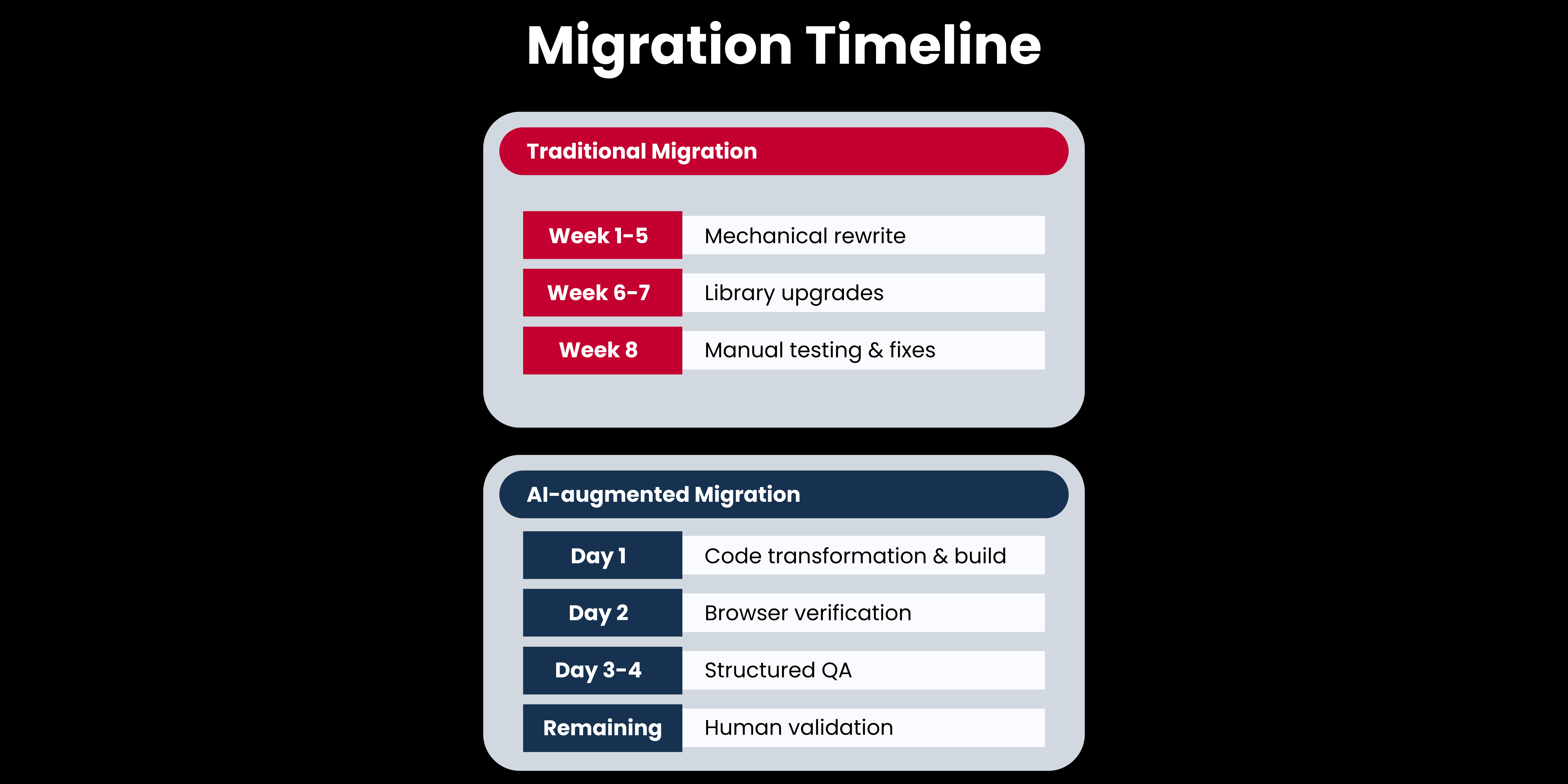
Traditionally, migrating from AngularJS to a newer version took 6–8 weeks of repetitive component rewrites, plenty of risk to delicate UI behavior, endless rounds of manual stabilization, and uncertain QA coverage. The more complex the application, the worse it gets.
With AI, I reached the main migration milestone in just one day—without all those headaches. The process was faster, smoother, and far less stressful.
With all that in mind, let’s see how the migration unfolded.
The Migration Architecture
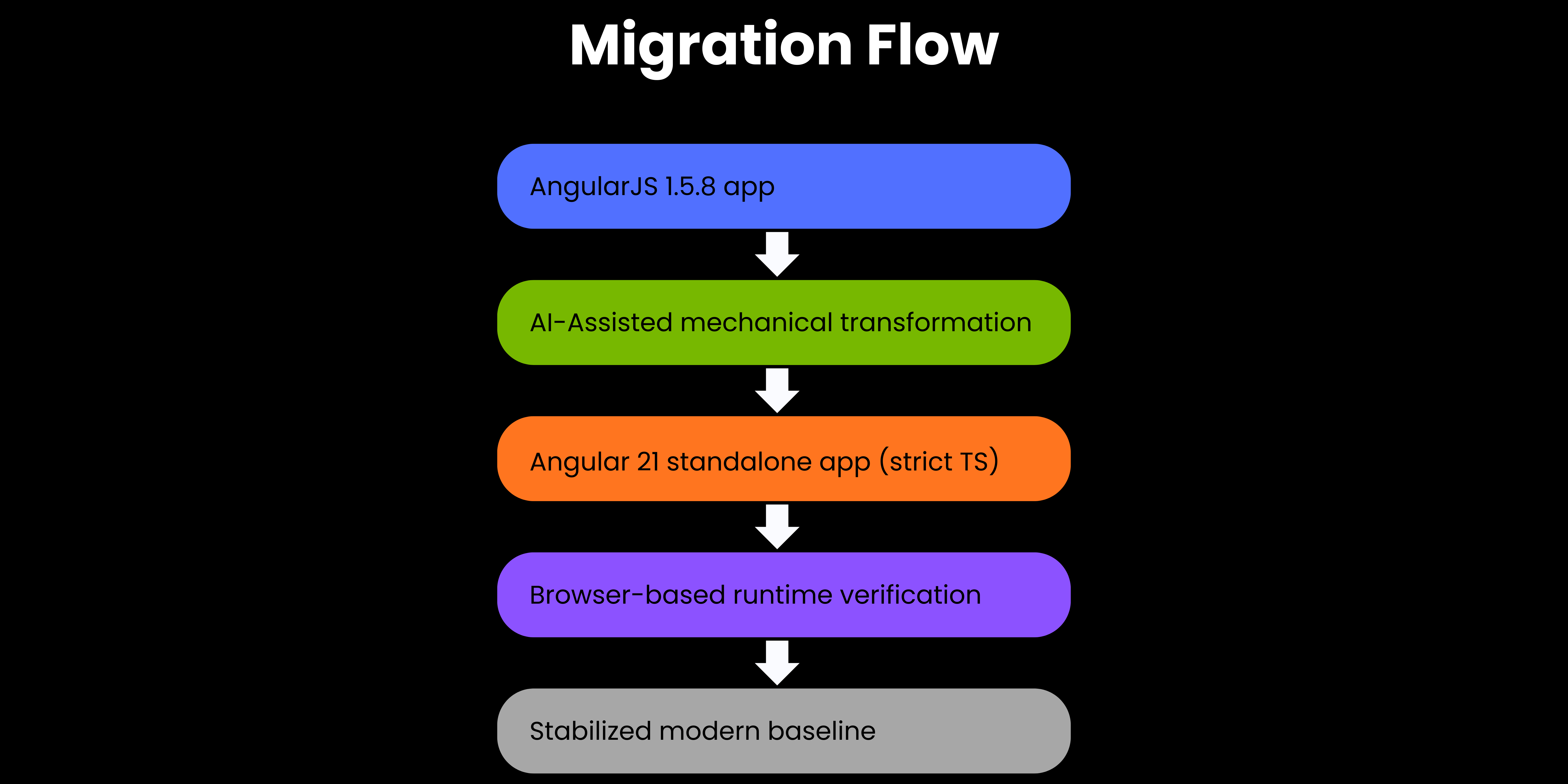
One of the things I did using AI to ensure a quick but safe migration was aligning the target stack with a modern baseline:
- Angular 21
- Standalone components
- Angular Router
- TypeScript strict mode
- ESM-based chart imports (amCharts 5)
- Zero jQuery
What AI Actually Did
During the alignment process, AI handled:
- Large-scale multi-file transformations
- AngularJS syntax → standalone component conversion
- Chart API migration (v3 → v5)
- jQuery elimination
- Type strictness enforcement
What started as a routine legacy modernization quickly became a showcase of what’s possible with the right tools. In just a single day, I delivered a huge milestone for one of our U.S.-based clients.
With that being said, I still retained ownership over some processes: architecture decisions, routing boundaries, strictness posture, acceptance criteria, and final milestone approval.
Why, you may ask?
Acceleration does not replace responsibility; it increases leverage.
While AI can dramatically speed up tasks such as code transformation, refactoring, and applying patterns, the responsibility for architectural decisions, system correctness, and final validation remains with us.
The Results
Despite the complexity of the original system, using AI enabled the transformation to proceed surprisingly quickly. Here are the big wins from this project:
| Metric | Result |
| Components migrated | 46 |
| Routes defined | 39 |
| Charts modernized | 10 |
| jQuery dependency | Fully removed |
| Build milestone | ng build passes |
| Time to milestone | ~1 full day |

Why “Build Passes” Is Not Enough
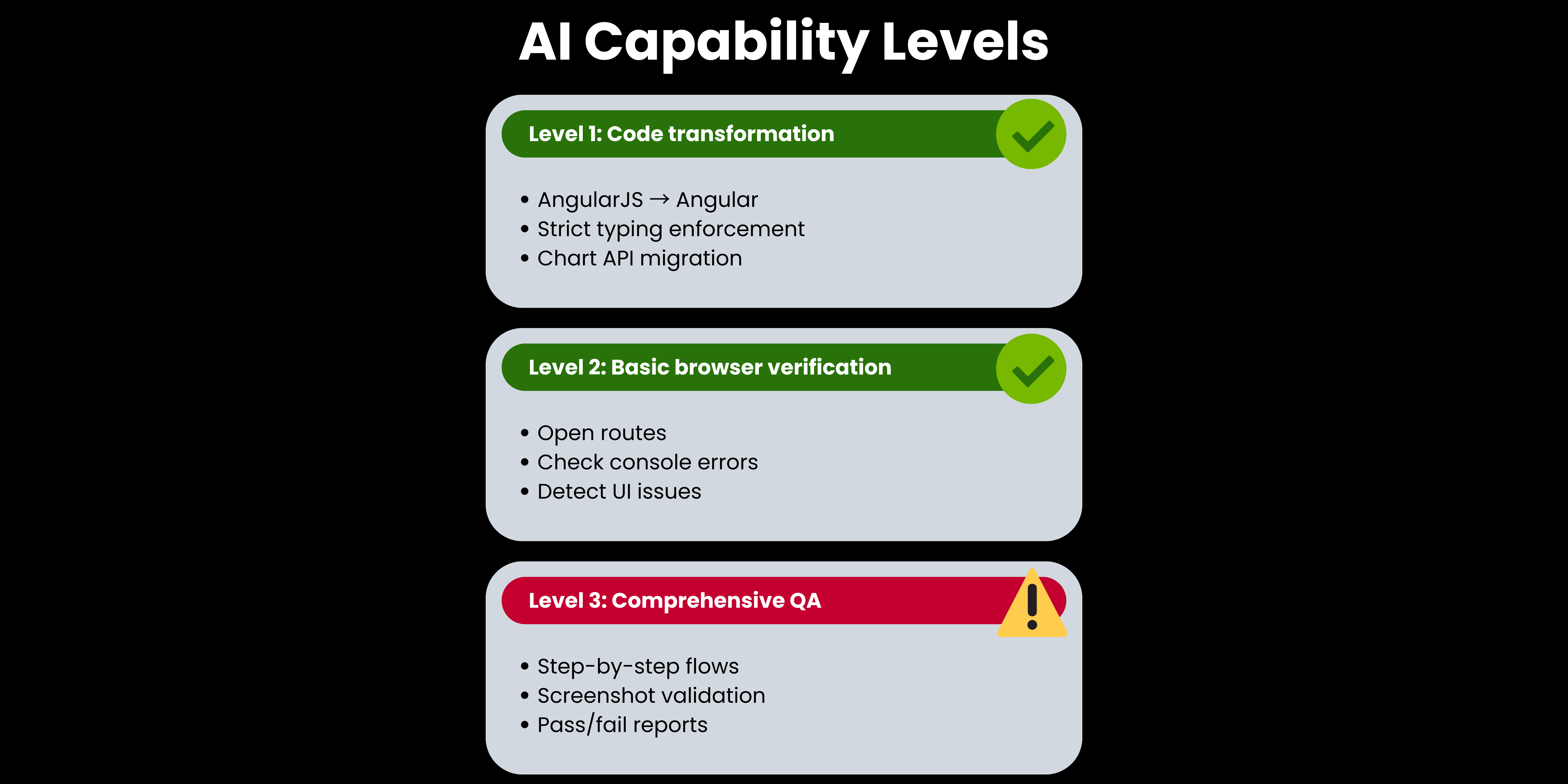
With the build milestone hit, remember one thing: just because the build says “success” doesn’t mean everything works. A green checkmark only confirms the app compiles—it doesn’t say anything about how it runs in the real world.
That’s why I ran browser-based smoke checks using an MCP-enabled workflow connected to a live Chrome instance.
Within minutes, it turned out that modals opened, but close buttons failed; images did not render; tables were visually broken; and architectural inconsistencies appeared, proving that, while very useful, AI still has its limitations.
The diagram below illustrates the actual capabilities of AI:
Migration Bottlenecks: Then vs. Now
Before AI, the slowest part of frontend migration was always the tedious refactoring: rewriting components, fixing bugs, and making sure everything still worked. It was a grind.
Now, thanks to AI, the big challenge isn’t the code transformation—it’s making sure your requirements and test scenarios are crystal clear.
If you know exactly what your app needs to do, AI-assisted testing can validate it quickly and thoroughly. But if your requirements are vague, validation will be shallow, and issues can slip through.
In short, the bottleneck has shifted from coding to defining clear, comprehensive test cases.
The Strategic Implication for CTOs
For CTOs, the cost of delaying an AngularJS-to-Angular 2 migration is no longer limited to technical debt: it increases security exposure, raises dependency risk, makes maintenance more difficult, and creates growing fragility with every future change.
Over time, even small product updates can become slower, more expensive, and more dangerous to implement, simply because the system is built on foundations that are no longer actively supported.
If you postponed AngularJS migration before, that was often rational.
However, this is no longer a stumbling block that will hold you back.
Today:
- AngularJS support is gone
- Risk is compounding with time
- The transformation cost has dropped dramatically
With AI-assisted transformation and a verification-first mindset, modernization does not mean a lengthy, high-risk rewrite. It can instead be a controlled architectural initiative that reduces long-term risk while speeding up the migration process, making it faster, cheaper, and far more manageable than it would have been just a few years ago.
Migration is no longer a multi-month rewrite initiative.
It’s an architecture and verification initiative.
And that changes the ROI equation.

Key Takeaways
1. You don’t need to fear AngularJS-to-Angular migration, even when targeting the latest Angular versions.
Modern tooling and AI-assisted workflows have changed the economics of this process. Even complex systems can now be transformed much faster than before, which means migration should no longer be viewed only as a technical burden, but as a realistic modernization strategy.
2. AI boosts your workflow, but it still needs to be monitored by your developers.
AI is highly effective at handling repetitive and mechanical tasks such as code transformation, refactoring, and pattern alignment. However, it does not replace developers’ roles in making architectural decisions, defining acceptance criteria, and verifying that the final system behaves correctly in real-world scenarios. In other words, AI can increase speed and leverage, but responsibility for the final outcome still remains with the engineering team.
If you’re evaluating an AngularJS migration in 2026, the question isn’t: “Can we afford to migrate?”
It’s: “Can we afford to carry unsupported infrastructure now that the cost barrier has dropped?”
If you’re interested in migrating from AngularJS to Angular with the help of AI, I can offer you a free, supplementary 30-minute consultation on this topic.
During this session, we can discuss the challenges you’re facing and explore effective solutions together. Don’t miss the chance to integrate AI into your development team’s workflow to enhance their coding speed.


 5 min
5 min